

Blog
No-Prep Classroom Games: 15 Fun Games You Can Run From One Screen
15 no-prep classroom games for elementary, middle and high school students that teachers can run from one screen, with no student accounts or downloads.
The easiest no-prep classroom games run from one screen at the front of the room: kids charades, Pictionary, a categories race, Taboo with kid-friendly cards, and a "stop the timer at 10 seconds" challenge. Open the game on the classroom computer or projector, split the class into teams, and the screen supplies the words, timer and score. Students don't need accounts, devices or downloads.
Below are 15 classroom games for elementary, middle and high school students, covering brain breaks, vocabulary practice and end-of-term fun, with the grade levels each one suits.
Key takeaways
Charades, Pictionary and Categories work for almost any grade and need only the board and two teams.
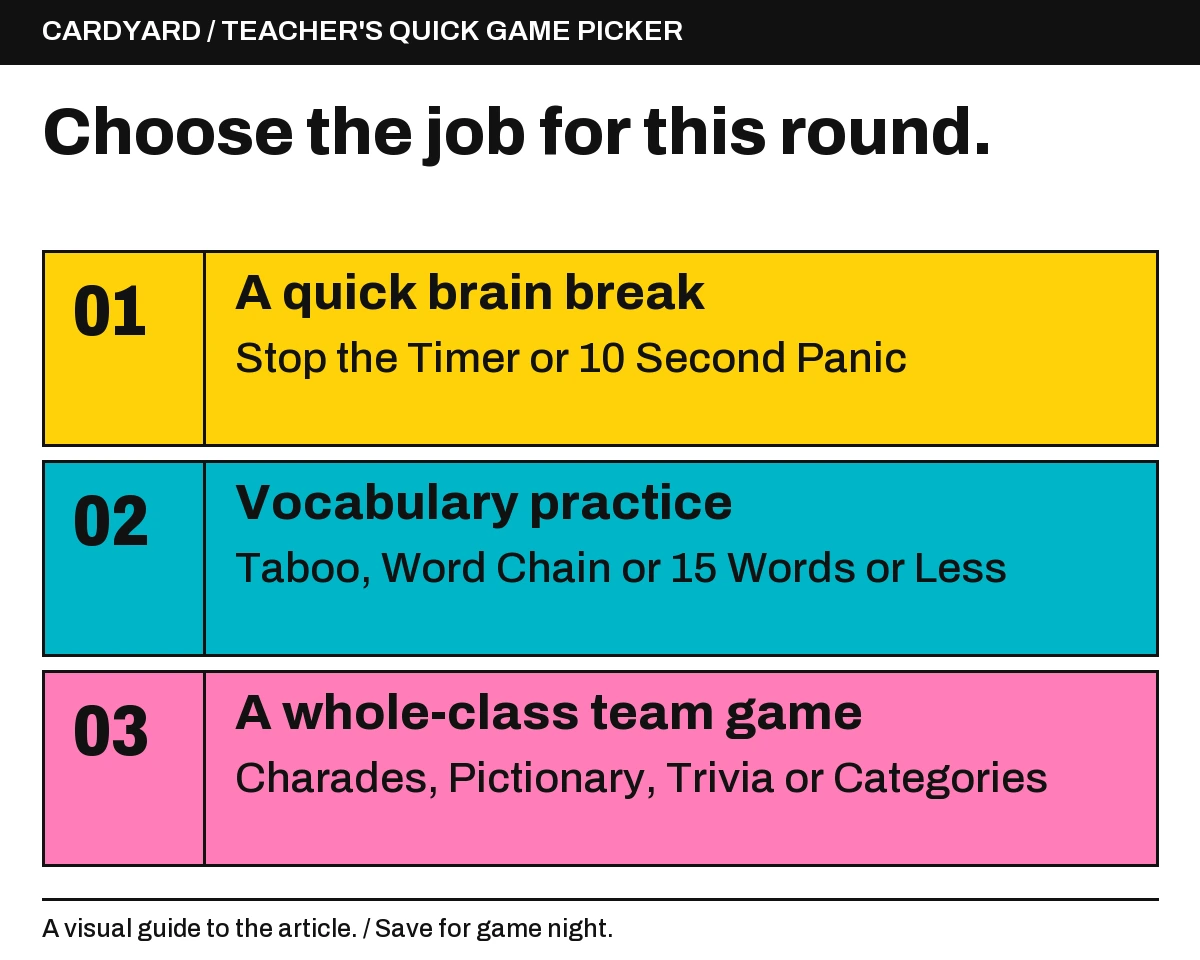
For a 2-minute brain break, run Stop the Timer or 10 Second Panic on the projector.
For vocabulary, use Taboo, 15 Words or Less and Word Chain to get students describing and connecting words.
CardYard's kids and family settings keep prompts classroom-friendly, and adult categories aren't part of free play.
Classroom games at a glance
Game | Grades | Time | Skill |
|---|---|---|---|
Kids charades | K to 5 | 10 to 20 min | Vocabulary, movement |
Pictionary | 1 to 12 | 15 min | Vocabulary, drawing |
Categories | 3 to 12 | 10 min | Vocabulary, spelling |
Taboo | 4 to 12 | 15 min | Describing, synonyms |
15 Words or Less | 5 to 12 | 15 min | Concise clues |
Word Chain | 3 to 12 | 5 min | Compound words |
Trivia | 3 to 12 | 10 to 20 min | Review |
Stop the Timer | K to 12 | 2 to 5 min | Brain break |
10 Second Panic | 3 to 12 | 5 min | Quick recall |
Would You Rather | K to 12 | 5 min | Speaking, reasoning |
Two Truths and a Lie | 5 to 12 | 15 min | Icebreaker |
Hue Hunt | 2 to 12 | 10 min | Describing |
Silent Ball | K to 8 | 5 min | Brain break |
Four Corners | K to 5 | 5 min | Brain break |
Buzz | 3 to 8 | 5 min | Multiples |
Team games for the whole class
1. Kids charades
The kids charades generator has 60 reviewed prompts for ages 4 to 12, such as "hop like a bunny," grouped into animals, actions, story characters and classroom moments. Show one prompt to the actor, start the timer, and let the class guess. You can print the cards, and the free charades host kit includes score sheets and a session plan.
2. Pictionary
Put Pictionary on the projector, show the word to one student, and let them draw on the whiteboard while their team guesses. Choose easy objects for younger grades and use vocabulary from your current unit for older ones.
3. Categories
Categories shows a random letter, an original list and a timer on one shared screen. Students write one answer per category on paper, and answers nobody else wrote score a point. The classic packs are free and unlimited, and the category lists give you more themes.
4. Trivia
Trivia shows one question with four options. Teams discuss, lock in an answer, and you reveal it. Use a subject deck for a quick review before a test.
Vocabulary games
5. Taboo
In Taboo, a student describes a word without saying the forbidden words on the card. Choose the kids category for younger classes. It builds synonyms and descriptive language, and it works well with English learners.
6. 15 Words or Less
15 Words or Less gives the clue-giver a set of target words and a limit of 15 spoken clue words, which the screen counts. For younger students, raise the limit to 25 words.
7. Word Chain
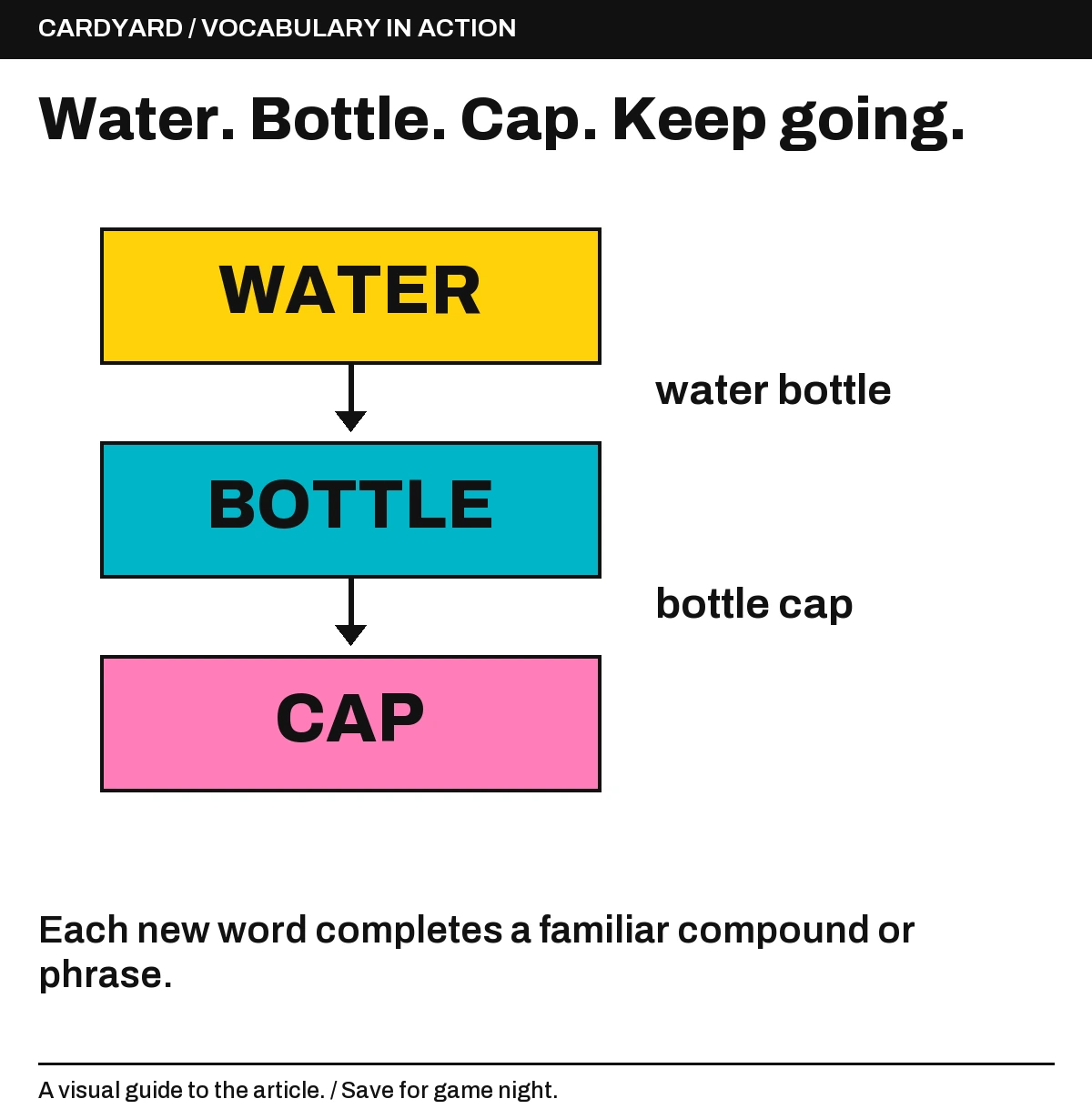
Word Chain links compound words and familiar phrases: water, bottle, cap. Play Solo against a 60-second clock on the board with the whole class calling answers, or let two students duel.
8. Hue Hunt
In Hue Hunt, one student picks a secret color and gives a short clue, and classmates guess on a board of 480 colors. It practices precise describing words, and up to 10 named players or teams can join.
Brain break games
9. Stop the Timer
Stop the Timer challenges students to stop a stopwatch at exactly 10 seconds. Turn on Blind Time to hide the clock and see who has the best internal timer. Party Mode supports 2 to 12 named players or teams.
10. 10 Second Panic
10 Second Panic shows a "name five" prompt, and a student or team has ten seconds to answer. Choose the easy deck for younger grades.
11. Would You Rather
Read a Would You Rather question and have students move to one side of the room to vote, then ask a few to explain. The Christmas Would You Rather list is family-safe and fits classrooms in December.
12. Silent Ball
Students toss a soft ball in silence; anyone who talks or drops a fair throw sits down, and the last student standing wins. It calms a loud room in minutes.
13. Four Corners
Number the corners of the room. One student counts to ten with eyes closed while everyone else picks a corner, then calls a number, and that corner sits down. Play until one student is left.
Getting-to-know-you and math games
14. Two Truths and a Lie
At the start of term, each student shares three facts, one false, and the class votes. Two Truths and a Lie keeps score for up to 12 players or teams. Our Two Truths and a Lie ideas help students who get stuck.
15. Buzz
Students count around the room, saying "buzz" instead of any multiple of a chosen number. Anyone who slips sits down. Edutopia recommends it as a no-prep way to practice multiples (Edutopia, retrieved 2026-10-17).
Tips for running games on the classroom screen
Preview the deck. Pick kids, family or easy settings and skim a few cards before class.
Use teams, not individuals. Two to four teams keep everyone involved and protect shy students.
Set a visible timer. Short rounds of 30 to 60 seconds keep the pace up.
Hide the answer. In charades, show the word only to the actor, then tap Hide word before the class looks up.
End on time. Brain breaks work best at 2 to 5 minutes.
Questions, answered
What are good no-prep classroom games?
Charades, Pictionary, Categories, Taboo, Stop the Timer and Would You Rather are good no-prep classroom games. Run them from one screen at the front of the room and split the class into teams.
What games can you play on a classroom projector or smartboard?
Categories, Trivia, Pictionary, 15 Words or Less, Stop the Timer and 10 Second Panic all run in a web browser on a projector or smartboard. Students play together without their own devices.
What are quick brain break games for the classroom?
Stop the Timer, 10 Second Panic, Silent Ball, Four Corners and Would You Rather each take 2 to 5 minutes. They get students moving or laughing and then back to work.
What classroom games work for middle and high school?
Taboo, 15 Words or Less, Categories, Trivia and Two Truths and a Lie suit older students because they reward vocabulary, quick thinking and teamwork.
Do students need accounts or devices to play?
No. The teacher opens the game in a browser on the classroom computer, and students play together from their seats. Nobody needs an account or a download.